

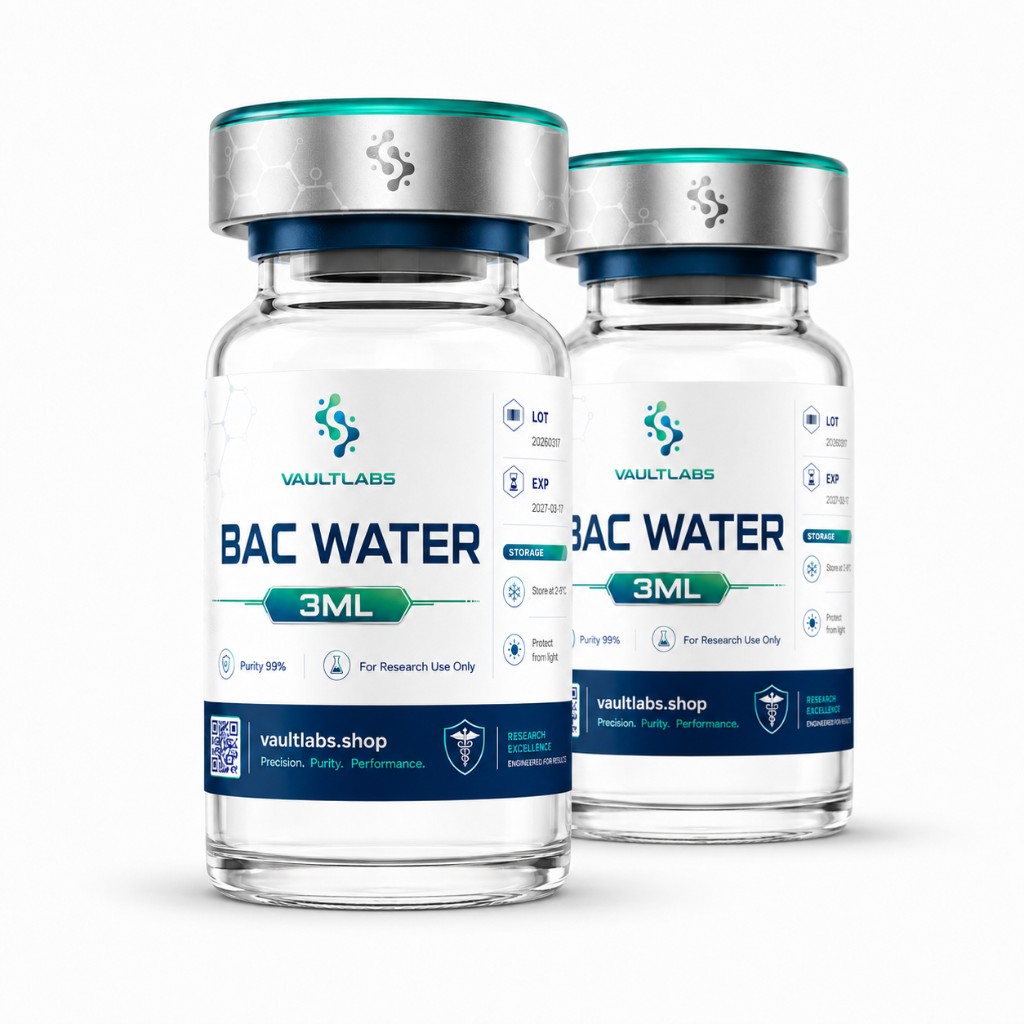
[BAC water](/compounds/bac-water) volume for UAE labs is 3 ml versus 10 ml, not “how much to add to a peptide.” Definition: BAC water. Working guide: BAC water guide.
Choose 3 ml when
- One bench, one peptide lot, limited calendar
- You want a new diluent lot next to each new peptide lot
- Training environments where a documentation error should waste less volume
SKU: BAC water 3ml.
Choose 10 ml when
- Several qualified in vitro methods will draw from one diluent lot in a short window
- Receiving would rather verify one diluent COA/lot than four
- Your SOP already tracks first-open dates on larger units
SKU: BAC water 10ml.
Size is a lot-control decision, not a volume calculation
The instinct is to estimate total diluent needed and buy that. It produces the wrong answer often enough to be worth resisting, because the binding constraint is usually lot control rather than millilitres.
Every diluent vial is a lot that has to be paired with each peptide lot it touches. One 10 ml unit spread across four peptide lots creates four pairings that all depend on a single record staying accurate; four 3 ml units create four self-evident pairings. The second arrangement costs more per millilitre and less per audit.
Working out roughly how much volume a study needs is still worth doing — it tells you whether 3 ml is plausible at all. But once two sizes are both workable, choose on how cleanly each keeps the diluent-to-peptide pairing visible in the record, not on unit price.
The cost of over-ordering volume
Buying larger than needed feels prudent and usually is not, for reasons that only show up later.
A part-used vial creates a standing question nobody wants to own: is it still usable, and on whose authority. Unless your SOP states a first-open policy and someone enforces it, that vial will sit in the fridge accumulating ambiguity until it is either used on a hunch or discarded well after it should have been.
Unopened stock has its own quiet cost. Diluent held long enough approaches its expiry, and expired diluent in a working fridge is a finding whether or not anyone intended to use it. Ordering closer to actual need, more often, is generally the cheaper discipline.
Shared vials are a paperwork risk
A 10 ml unit used across unrelated peptide lots is fine only if the ELN still shows diluent lot + peptide lot every time. If that pairing gets lost, smaller units are cheaper than an audit finding.
The BAC water calculator helps with arithmetic your SOP already defined. It does not pick 3 ml or 10 ml for you.
UAE receiving
Same heat discipline as peptides: out of ambient, labelled, inventoried. Do not store diluent as “misc water.” Research-use invoicing: research use policy.
In vitro laboratory use only.

