

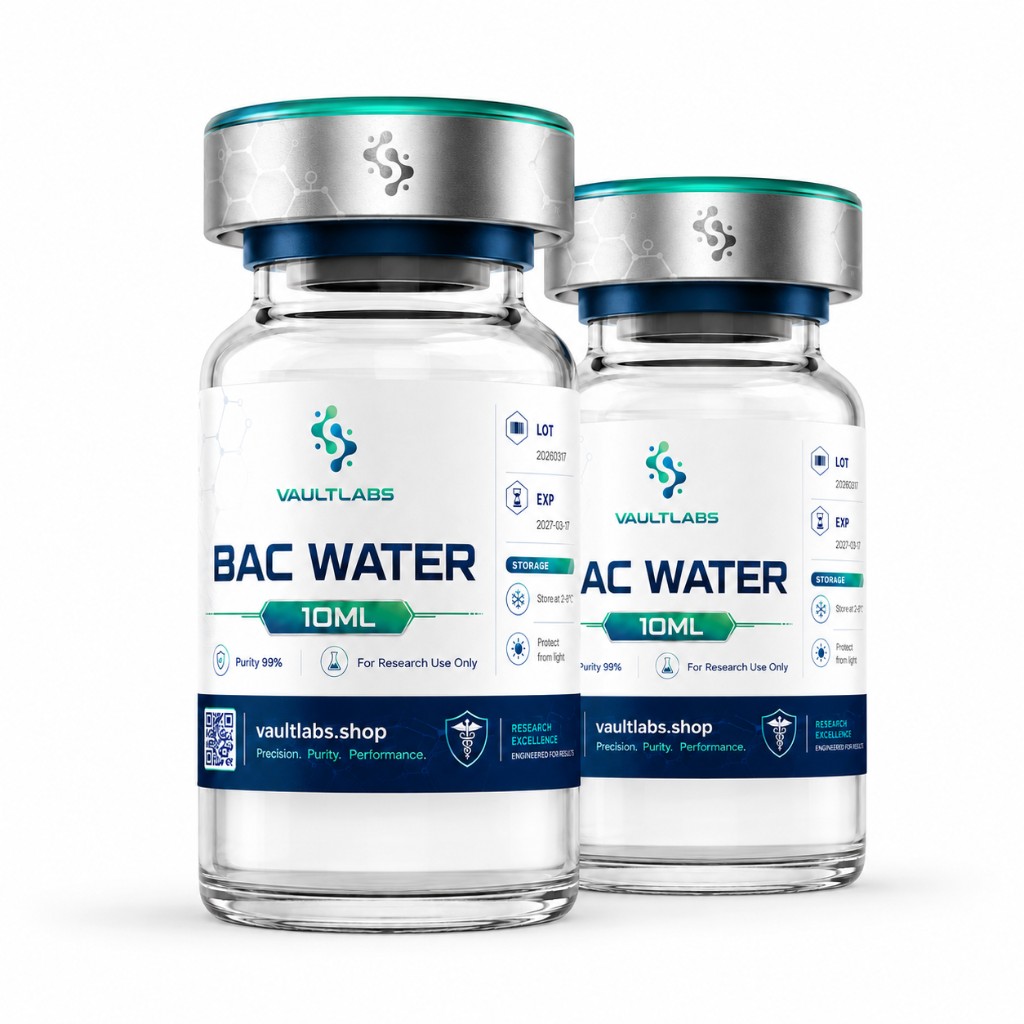
BAC water (bacteriostatic water) in this catalog is a research diluent with its own lot, label, and storage line. The definition page is BAC water. This guide is what a receiving officer should actually do with that SKU.
Identity
VaultLabs lists BAC water 3ml and BAC water 10ml. Benzyl alcohol as a bacteriostatic component is why this is not the same identity as sterile water. If a protocol says “sterile water,” a BAC water vial is a substitution, not a synonym.
Documentation
- Diluent lot on the same ELN line as the peptide lot
- Expiry or first-open date per your SOP
- Calculator inputs if you use the BAC water calculator
The peptide-side method page is reconstitution basics. The UAE workflow is peptide reconstitution guide UAE.
What bacteriostatic actually means here
The prefix does a lot of work in marketing copy and very little in a laboratory record, so it is worth being precise about the claim.
Bacteriostatic describes an agent that inhibits bacterial growth, as distinct from bactericidal, which kills. The distinction is not pedantry: inhibiting growth in a preserved diluent is a different property from sterilising a preparation, and one does not substitute for the other. The preservative in bacteriostatic water is benzyl alcohol.
That single fact drives the whole documentation difference. The diluent is not inert — it introduces a component into whatever it is added to, which is precisely why it is a separate catalog identity with its own lot rather than a generic "water" line on a requisition. It is also why a protocol written for a non-preserved diluent cannot silently accept a preserved one.
Benzyl alcohol is also relevant to protein-containing preparations for reasons covered on the BAC water monograph, which is the page to read before deciding the two diluents are functionally equivalent for your method.
Deciding which diluent your method needs
This is an SOP decision, and the honest framing is that it turns on whether the preparation will be accessed more than once and whether your method tolerates an added preservative.
A preserved diluent supports a multi-draw workflow, which is the usual reason to choose it. A non-preserved diluent avoids introducing benzyl alcohol, which matters when the method is sensitive to it or when the preparation is single-use anyway. Neither is the default; the method decides.
What is not a valid basis for the decision: vial size, what was in the fridge, what a product photo showed, or what a previous study used without anyone recording why. If your SOP does not state the diluent, that is the gap to close before ordering — not something to resolve at the bench with the peptide already open.
What BAC water is not
- A protocol
- A preservative story for human multi-use
- A reason to skip peptide COA checks
- Interchangeable with sterile water on a purchase order
Storage
Follow the BAC water label. Do not assume peptide fridge rules apply to every diluent. Sealed peptide policy: storage guide.
UAE buying
AED checkout, research-use acknowledgement, dispatch across emirates. Volume choice: BAC water volume for UAE labs.
In vitro research only.


