

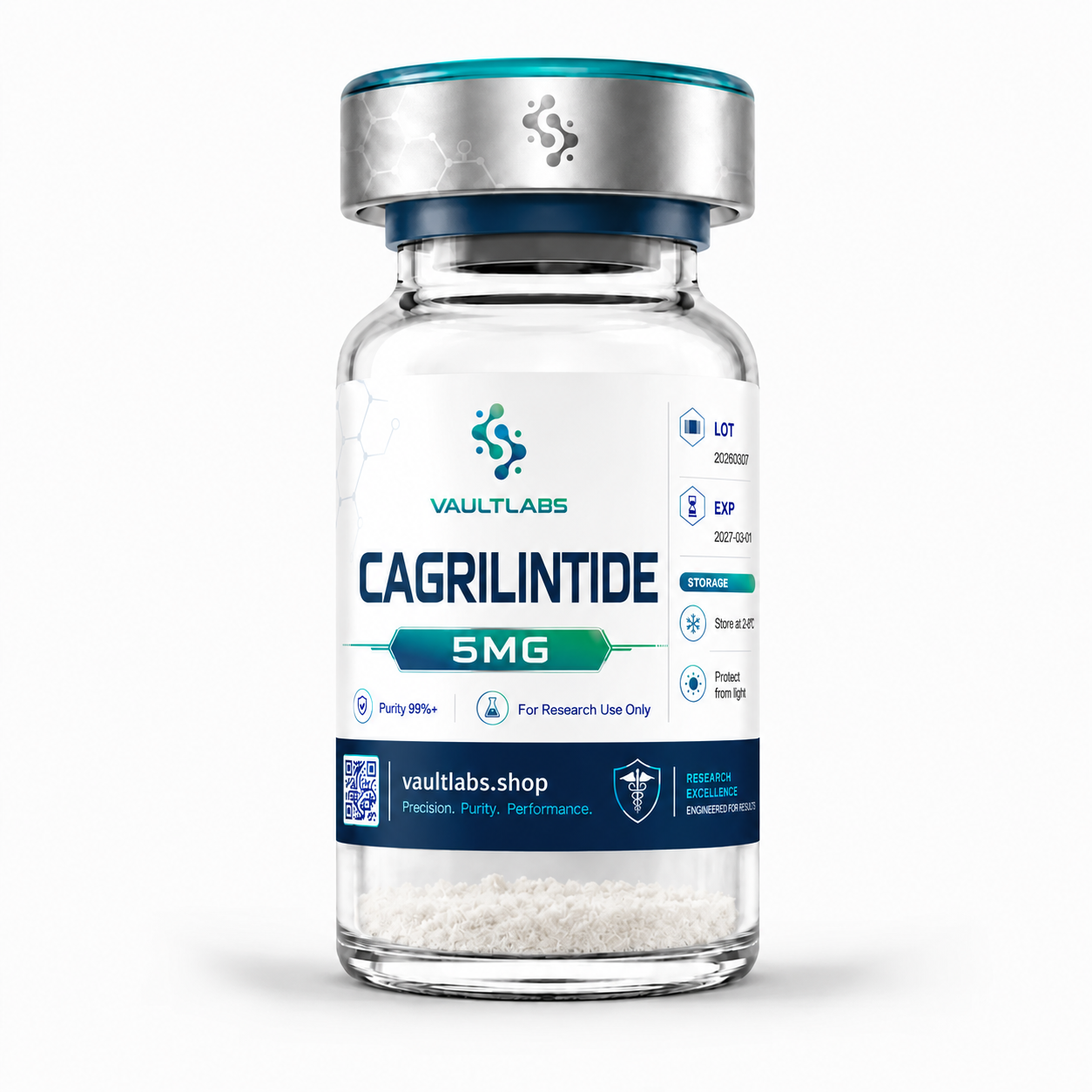
No. Cagrilintide is not semaglutide, not retatrutide, and not the RETA/CAG blend. Those four strings are four catalogue identities. A laboratory that files them as strengths of one peptide will attach the wrong certificate to the wrong vial.
Cagrilintide, on this catalogue, is a long-acting amylin analogue. Public records describe a 38-residue peptide with a fatty diacid and a disulfide. The registry number used here is CAS 1415456-99-3, formula C194H312N54O59S2, molecular weight 4409.07 g/mol. The stocked fills are Cagrilintide 5mg and 10 mg. Each fill has its own lot. The owner page for the chemistry is the cagrilintide monograph. The UAE ordering page is cagrilintide for laboratories.
What each of the other names actually is
Semaglutide is a GLP-1 receptor agonist, CAS 910463-68-2. VaultLabs lists it as semaglutide 30mg. It is not an amylin analogue, and a paper that studies the two together is describing two substances. The supply page is semaglutide research peptide UAE.
Retatrutide is a different sequence again, CAS 2381089-83-2. On this site the single-sequence line is named GLP-3 RT, from 5 mg through 100 mg. The usual commercial URL is GLP-3 RT 10mg. Ordering context sits on retatrutide research peptide UAE, and the chemistry sits on the retatrutide monograph. How retatrutide and semaglutide get swapped on purchase orders is already covered in retatrutide versus semaglutide. This page adds cagrilintide and the blend, which that article does not settle.
RETA/CAG is not a nickname for either single sequence. RETA/CAG 15mg contains 12.5 mg of retatrutide and 2.5 mg of cagrilintide in one vial. The 15 mg figure is the total fill. It is not 15 mg of cagrilintide, and it is not a 15 mg GLP-3 RT vial. The blend keeps its own lot. The monograph is RETA/CAG.
| Cagrilintide | Semaglutide | GLP-3 RT | RETA/CAG | |
|---|---|---|---|---|
| Class | Amylin analogue | GLP-1 receptor agonist | Retatrutide alone | Two-peptide blend |
| CAS | 1415456-99-3 | 910463-68-2 | 2381089-83-2 | No single CAS |
| Catalogue fill | 5 mg and 10 mg | 30 mg | 5 mg to 100 mg | 15 mg total |
| In the vial | Cagrilintide only | Semaglutide only | Retatrutide only | 12.5 mg retatrutide + 2.5 mg cagrilintide |
Why the names collapse in search
People shorten cagrilintide to “cagri”, retatrutide to “reta”, and then write RETA/CAG as if it were a strength code. Published trials also put cagrilintide next to a GLP-1 agonist in the same study title. That is a reason the names travel together. It is not a reason the vials are interchangeable. A co-administration study describes two materials. A blend vial is a third material, with both sequences in one container and one lot record.
The same collision happens inside this catalogue without any outside paper. GLP-3 RT 15 mg and RETA/CAG 15 mg both contain the number 15. Only the blend contains cagrilintide. Write the full catalogue string on the requisition.
What receiving has to match
Before a vial leaves quarantine, four strings have to agree:
- Catalogue name on the invoice, not “GLP” or “cagri”.
- Printed name and nominal mass on the vial.
- Lot on the vial and lot on the certificate.
- Identity on the certificate: one sequence, or the two named components of the blend.
A strong chromatogram for the wrong identity is still a failed receipt. Check the lot in batch verification. Field-by-field review is in how to read a peptide COA. If the public lot page is empty, raise a documentation request and hold the unit.
A 5 mg cagrilintide certificate does not release the 10 mg fill. A GLP-3 RT certificate does not release RETA/CAG. A semaglutide certificate does not release either of them.
What to write on the purchase order
Use one of these strings, plus the fill:
- Cagrilintide 5 mg, or cagrilintide 10 mg.
- Semaglutide 30 mg.
- GLP-3 RT, with the milligram fill the protocol’s stock-solution maths was written for.
- RETA/CAG 15 mg, and a note that the vial is 12.5 mg retatrutide plus 2.5 mg cagrilintide.
“Reta 15” is not a complete line. It can mean GLP-3 RT 15 mg or the blend. The peptide calculator only converts mass and volume after the identity is already locked. It does not choose a compound.
Storage for sealed lyophilized vials follows the printed label, generally 2–8 °C, protected from light. Move UAE deliveries into cold storage when they are signed for. Invoicing is in AED. The research use policy is the scope: in vitro laboratory research only.
What this page will not decide
It will not rank the four materials. It will not interpret trial outcomes, and it will not say which sequence a method should use. That choice belongs to the written protocol. If the protocol names cagrilintide alone, order the cagrilintide fill. If it names retatrutide alone, order GLP-3 RT. If it names the combination as one vial, order RETA/CAG and file that lot, not the two single-sequence certificates beside it.


