

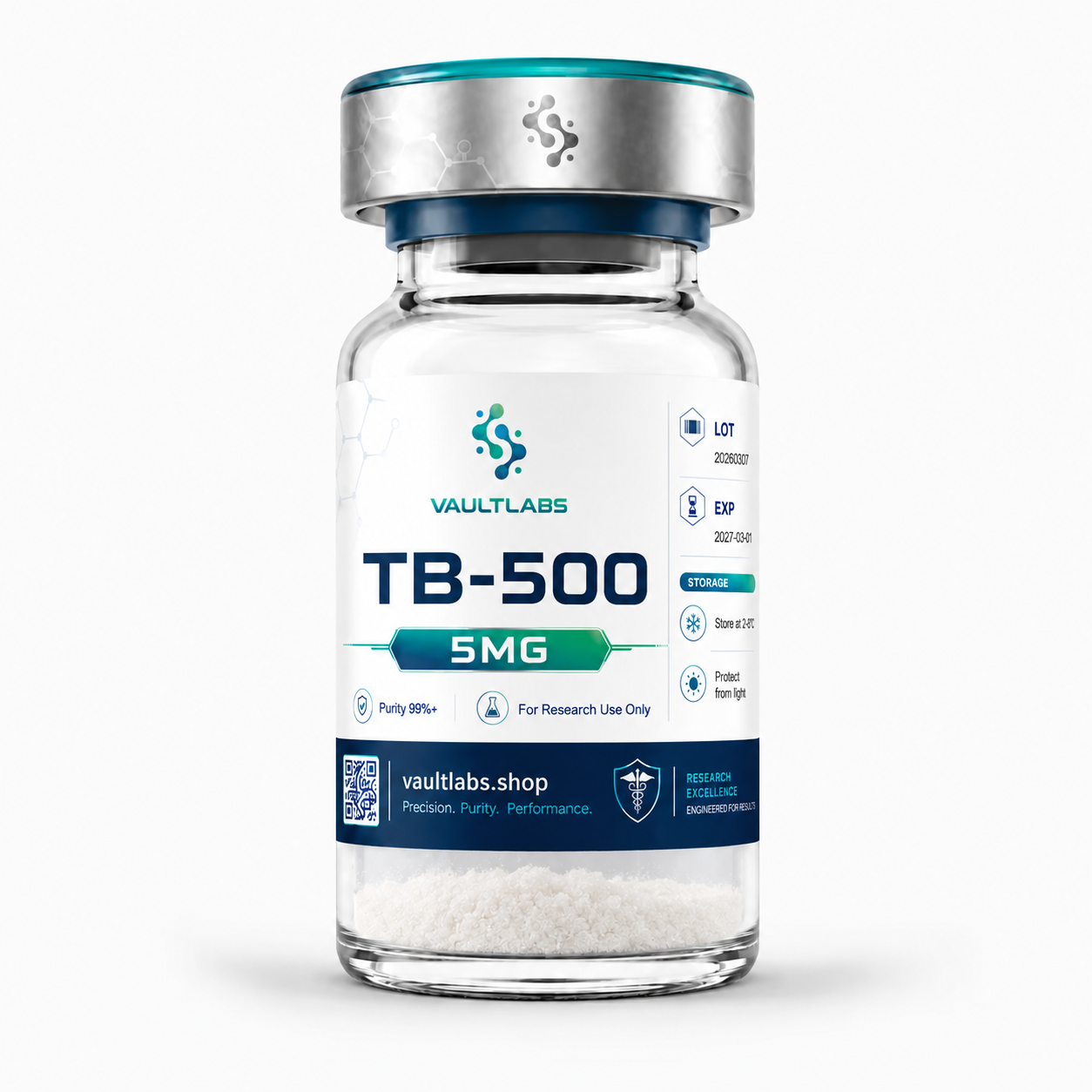
No. [TB-500](/product/tb-500-5mg) is not thymosin beta-4. Thymosin beta-4 is a 43-residue protein and one of the abundant actin-sequestering molecules described in mammalian cells. TB-500 is a research-supply name for a much shorter synthetic peptide corresponding to the actin-binding region of that protein, most often the LKKTETQ motif.
That distinction is the whole page. Supplier listings blur it. A vial labelled TB-500 and a material labelled thymosin beta-4 are different masses, different chromatography, and different literature. Results written about the parent protein do not automatically transfer to the fragment, and the reverse is also true. If a method cites the 43-residue protein and the bench holds a fragment, the record should say that the substitution happened.
VaultLabs stocks the fragment as TB-500 5mg. It does not stock the 43-residue protein. The chemistry and the naming warning live on the TB-500 monograph. UAE ordering notes are on TB-500 for laboratories.
What the catalogue name is allowed to mean
“TB-500”, “TB4 fragment”, and “thymosin beta-4 fragment” can all point at a short synthetic peptide. “Thymosin beta-4” without the word fragment points at the parent protein. Because vendors swap these strings, the certificate has to state the sequence. A trade name on a carton is not that statement.
The motif most often referenced in supply contexts is LKKTETQ, the actin-binding region of the parent protein. Confirm that the lot in your hand says so, or says a different sequence explicitly. Do not infer the sequence from the product title after the vial has already been logged.
| TB-500 on this catalogue | Thymosin beta-4 | |
|---|---|---|
| What it is | Short synthetic fragment | 43-residue parent protein |
| Motif | Actin-binding region, often LKKTETQ | The full protein that contains that region |
| Catalogue | TB-500 5 mg | Not a VaultLabs SKU |
| Certificate | The lot on that 5 mg vial | A TB-500 COA does not describe it |
Neighbouring vials that are also not this question
BPC-157 versus TB-500 answers a different mix-up: two repair-associated sequences that are not fragments of each other. BPC-157 is its own 15-residue peptide, CAS 137525-51-0, in 10 mg and 20 mg vials. A BPC-157 certificate does not release TB-500.
Wolverine is a blend, not a synonym. TB-500 versus Wolverine separates the standalone 5 mg fragment from a 10 mg two-component vial that pairs TB-500 with BPC-157. The 10 mg on Wolverine is a total, not 10 mg of TB-500. KLOW also names TB-500 as one constituent among others. A blend certificate is not the standalone fragment’s certificate, and the fragment’s certificate is not the blend.
Receiving a fragment without adopting the protein’s name
On the purchase order write TB-500 5 mg, not “thymosin” and not “TB4” alone. At the bench, match:
- Catalogue name TB-500 and nominal mass 5 mg.
- Lot on the vial and lot on the certificate.
- Sequence or identity field. If the certificate says a short fragment, file it as a fragment. If a document claims the full 43-residue protein, it does not belong to this SKU.
- A separate file if the order was actually BPC-157 or a blend.
Check the printed lot in batch verification. Review fields with how to read a peptide COA. Unpublished lots wait on a documentation request.
Short fragments are worth a mass check when the laboratory can do one, because a truncation is not always obvious on a single chromatogram. Sealed lyophilized vials are held at 2–8 °C, protected from light. Once opened, oxidation and contamination matter more for a short peptide than the carton copy does. Log open-vial time. The certified figure applies to the lyophilized lot as released.
Thymosin beta-4 and related peptides are on the World Anti-Doping Agency prohibited list. Laboratories tied to athlete testing should treat accountability accordingly. That listing is a compliance fact. It is not an identity test, and it does not make the fragment and the protein the same molecule.
What this page will not decide
It will not claim that the fragment reproduces the parent protein in an assay. It will not provide a method. It will not rank TB-500 against BPC-157. If the protocol names the 43-residue protein, this 5 mg vial is the wrong material. If the protocol names the fragment, order TB-500 5mg, file that lot, and keep the protein’s literature labelled as the protein’s literature.


