

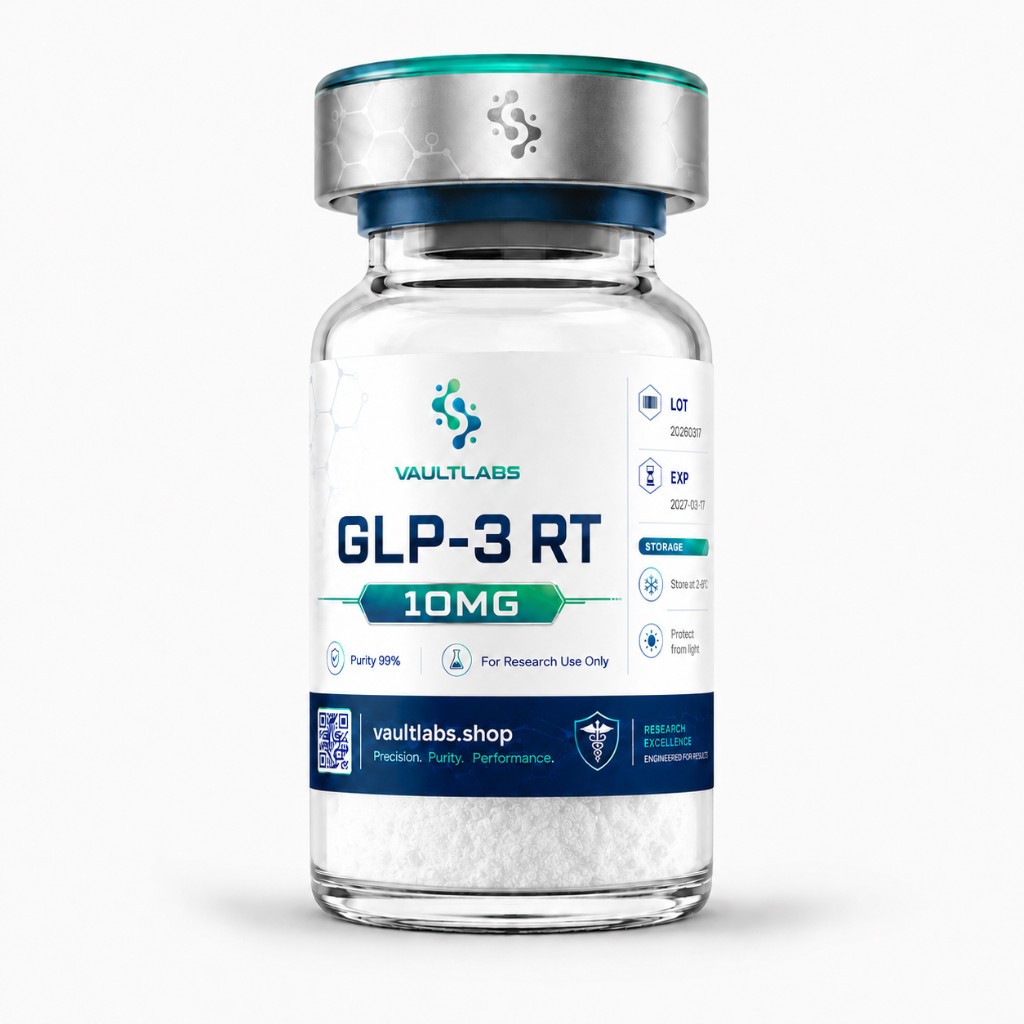
The first practical difficulty with retatrutide is not sourcing it. It is being certain that the thing on the requisition, the thing on the quotation, and the thing in the box are the same material. This compound circulates under a research designation, a catalogue abbreviation, and a blend name that shares part of its stem, and a UAE laboratory that does not resolve the naming before ordering will eventually book in something it did not intend to buy. Everything below concerns identification, formats, and lot records for in vitro laboratory work.
Resolve the naming before the requisition
Fix one internal name, map it to one SKU code, and write the mapping down. In this catalogue the material is listed under the GLP-3 RT designation, and the compound reference page is retatrutide. If your reviewer's paperwork uses a different string, record both on the same line of the inventory master rather than expecting each person to translate. Naming drift is silent — nothing fails, the wrong material simply gets used and the record looks fine.
Vial formats and what changes between them
Two sealed formats are listed: the 10 mg vial and the 20 mg vial. The difference is quantity per sealed unit, and the decision is a handling decision rather than a value one. A larger unit opened repeatedly across months accumulates exposure events; two smaller units consumed cleanly do not. In a humid coastal climate that distinction matters more than the per-milligram arithmetic that usually drives the choice.
Both formats carry AED pricing and are dispatched across the seven emirates. Confirm availability on the listing rather than from a saved quotation, since stock states change.
A blend is a different SKU, not a variant
There is a separate listed material, reta-cag, whose name shares a stem with retatrutide. It is not a size variant or a packaging alternative of the same thing, and substituting one for the other because a requisition was ambiguous is a real failure mode. The differences are laid out at reta-cag versus retatrutide. If a supplier or an internal colleague offers one as a substitute for the other, that is a change of material and should be handled as one.
Lot records before qualification starts
Analytical records describe a single production lot. Enter the lot identifier from the vial into the batch verification portal before internal qualification begins, not after, because discovering that a record is pending halfway through a booking-in process wastes the work already done. VaultLabs publishes per-lot records where they have been uploaded; a lot without a published record is not necessarily a problem, but it is a fact your file should state explicitly rather than leave blank. A worked example of this receiving sequence is at retatrutide COA verification.
Comparisons that are actually useful
Laboratories frequently ask how this material relates to others in the same catalogue area. The structured comparison at retatrutide versus semaglutide sets out what differs at the level of identity and catalogue specification. It does not recommend one over the other, and it should not be read as doing so — selection sits with the laboratory. Storage notes specific to the SKU are collected at the retatrutide storage guide.
What is deliberately not published
No preparation instructions, no administration guidance, no protocol design, and no interpretation of what any analytical figure implies for a study. This is a consistent position across the catalogue rather than a gap, and it is stated in the research use policy.
FAQ
Is retatrutide intended for consumption?
No. It is supplied as a reference-grade research material for laboratory work, and the catalogue carries no consumer or clinical positioning of any kind.
Why is the listing labelled GLP-3 RT rather than the full name?
It is a catalogue designation. Map it to whatever internal name your institution uses, and keep both strings on the inventory record so the requisition and the delivery note can be reconciled.
Can VaultLabs advise on protocols or study design?
No. Reference-grade material and lot records are supplied; design decisions belong to the laboratory.
Is the 20 mg vial better value than two 10 mg vials?
That depends entirely on how many separate opening events your workflow requires. Per-milligram price is only one input, and it is usually the least important one. All formats are supplied for in vitro laboratory research only.