

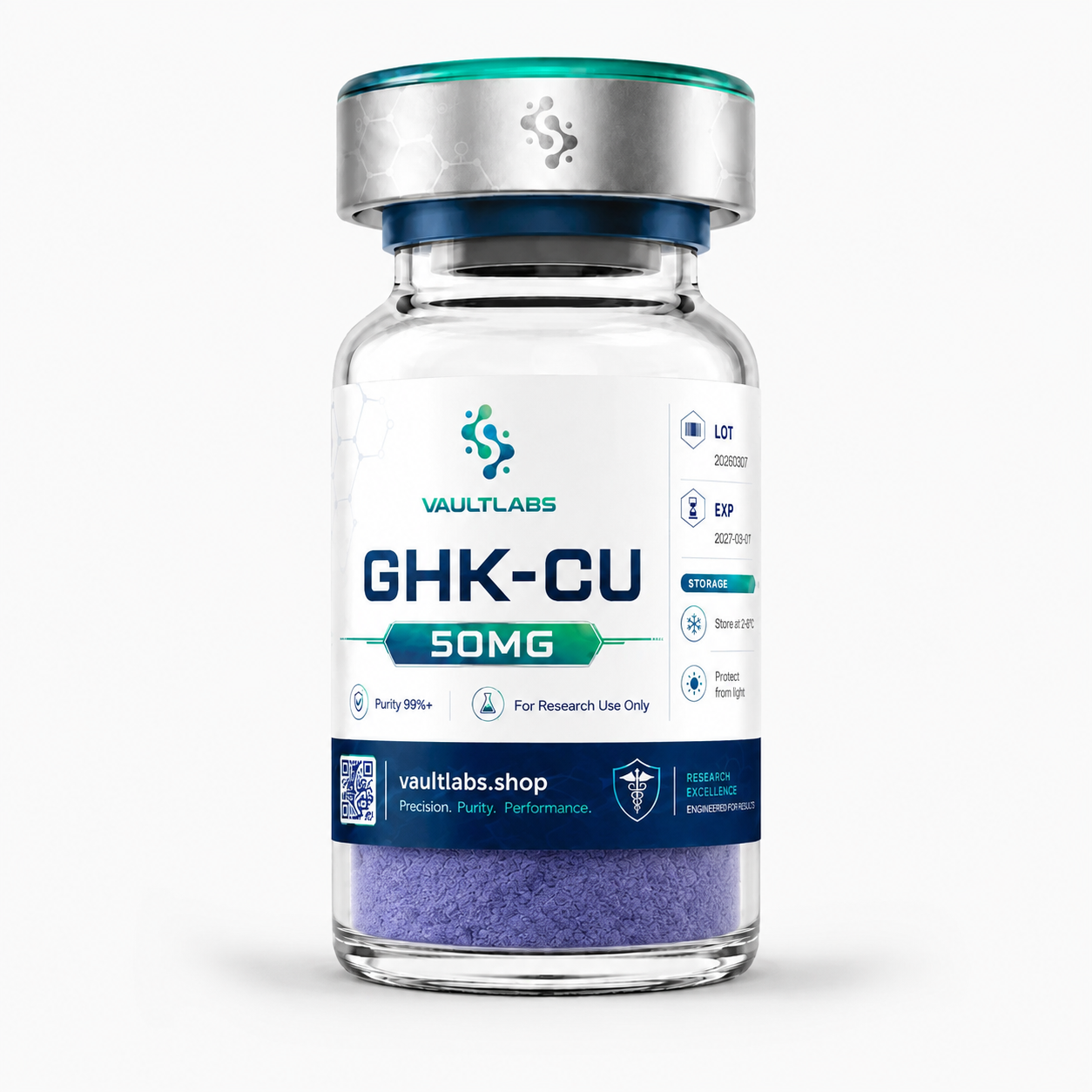
GHK-Cu is the copper-complexed tripeptide that most UAE cosmetic-science and in vitro laboratories encounter first, and it is unusual in this catalogue for a practical reason: it is ordered in two quite different physical formats, and the two are not interchangeable in a receiving workflow. A sealed vial and a bulk raw powder raise different questions about weighing, aliquoting, record-keeping, and shelf life once opened. Choosing the wrong one is the most common ordering error in this category.
Sealed vials versus raw powder
A sealed vial arrives as a single unit with one lot and one intended opening event. Raw powder arrives as a bulk quantity intended to be subdivided, which means your laboratory becomes responsible for the record chain from the moment the container is first opened. If you cannot weigh accurately, cannot document each subdivision against the parent lot, and cannot store the remaining bulk under the printed condition, order vials. The format differences are described at GHK-Cu raw powder research formats, and the bulk listing is at GHK-Cu raw powder.
For vial formats, the 50 mg listing and the 100 mg listing carry current specifications and AED pricing. The size comparison is written up at GHK-Cu 50 mg versus 100 mg.
Appearance is a real receiving check here
Most lyophilised research peptides arrive as a white or off-white cake, and appearance is a weak signal. GHK-Cu is a copper complex, so colour is a more informative observation than usual and is worth recording explicitly in the receiving log rather than ticking off as "as expected". Note what you see, note what the lot record's appearance line says, and record any disagreement rather than resolving it silently. That disagreement is information; a technician's assumption is not.
This does not make appearance a substitute for analytical documentation. It is a fast check that sits alongside lot matching, not above it.
Sizing an order without over-buying
The temptation with a material used across several workstreams is to order the largest available format once. Consider instead how many separate opening events the material will see. Each opening of a sealed unit is an exposure to ambient humidity, and in this region that is not a trivial consideration. Several smaller units consumed cleanly often preserve material integrity better than one large unit opened repeatedly over months — and they keep the lot-to-record mapping simpler, because each unit has one lot and one record.
Where GHK-Cu sits in the catalogue
GHK-Cu appears in the cosmetic research category alongside related copper peptide materials, and the compound reference page is GHK-Cu. Where a laboratory is deciding between GHK-Cu and a structurally related material, the comparison at AHK-Cu versus GHK-Cu sets out the differences without making the choice for you.
Documentation for cosmetic-science workflows
Laboratories working in formulation and cosmetic science often have documentation obligations that differ from analytical chemistry groups, but the lot discipline is identical. Records are published per lot where they have been uploaded; check the one on your label through COA verification. If your workflow subdivides bulk material, keep the parent lot identifier attached to every daughter container, because a weighed aliquot with no parent reference is untraceable material no matter how carefully it was handled.
FAQ
Is GHK-Cu supplied as a skincare product?
No. It is supplied as a reference-grade research material. The catalogue is positioned research-use-only and carries no cosmetic or consumer product claims.
What purity information is available?
Analytical values appear on the lot record where one has been published. Read the method line alongside any figure, since values are only comparable under comparable methods.
Should I order raw powder or vials?
Order vials unless your laboratory can weigh accurately and document every subdivision against the parent lot. Bulk formats transfer the record-keeping burden to you.
Does the colour of the material confirm identity?
No. It is a useful receiving observation to record, but identity is established by the lot record and the methods it names, not by visual inspection. All formats are supplied for in vitro laboratory research only.