
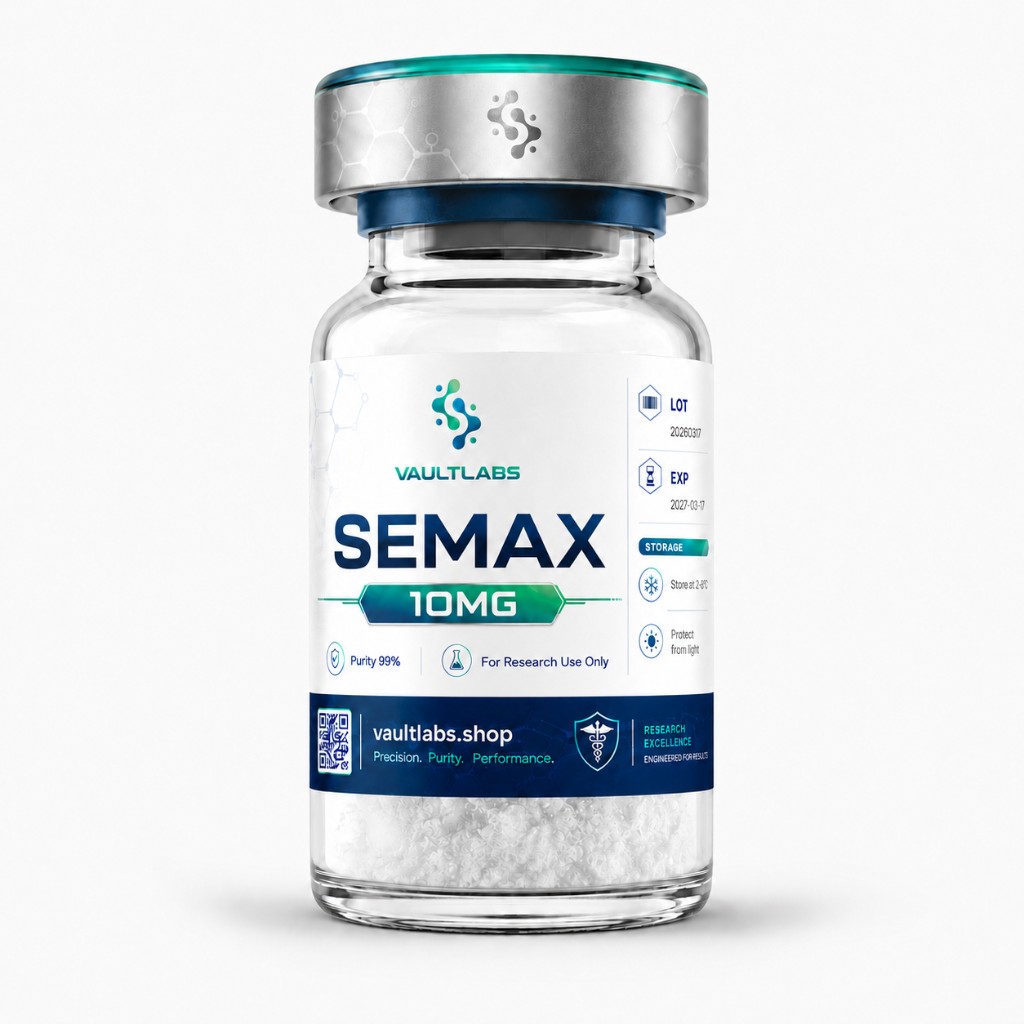
Semax reaches purchasing under more names than almost anything else in the catalogue. Papers write MEHFPGP or ACTH(4-7)-PGP. Suppliers write Semax. The VaultLabs vial is printed SEMAX 10mg. All three refer to one seven-residue peptide, Met-Glu-His-Phe-Pro-Gly-Pro, CAS registry number 80714-61-0, molecular formula C37H51N9O10, molecular weight 813.87 g/mol. A requisition citing the letter string will not match an invoice citing the catalogue string, and that mismatch is where a receiving officer starts improvising. The identity record belongs to the Semax compound monograph; this page covers the catalogue mapping and the paperwork.
The acronym is the receiving problem
MEHFPGP is not a supplier code. It is the single-letter sequence written out, and it appears in the literature precisely because the sequence is short enough to spell. A requester who copies it onto a purchase line has given purchasing something that looks like a part number and is not.
Fix it once with a crosswalk row: literature name, sequence string, catalogue string as printed, SKU, inventory row. After that, a requisition naming ACTH(4-7)-PGP resolves without anyone guessing at the fridge door. Skip it, and each new requester re-derives the mapping from scratch.
The ACTH association that gets misread
The first four residues correspond to a fragment of adrenocorticotropic hormone; the final three, Pro-Gly-Pro, are a synthetic addition. That lineage means the compound is frequently filed mentally as a hormone fragment, which then drives inappropriate handling assumptions and occasionally an inappropriate enquiry. The literature describes Semax as lacking the corticotropic activity of the parent hormone, because the retained fragment sits outside the region responsible for it.
State that precisely in your internal record rather than leaving the ACTH association unqualified. An unqualified note in an inventory system is the kind of thing that gets read back to you in an audit.
The Russian registration fact, and what it does not mean
Semax is registered as a medicine in Russia. It is not approved by the UAE Ministry of Health and Prevention, the FDA, or the EMA. Those two statements sit side by side and purchasing teams regularly draw the wrong conclusion from the first one, assuming that a compound registered somewhere can be handled as a pharmacy item here.
It cannot. What VaultLabs supplies is a lyophilised research reference material with lot-linked documentation, and the order is accepted against a research-use declaration retained in the order record. The terms are set out in the research use policy. Keep the corresponding record on your side too: the research aim, the approving signature, and the workflow the lot entered.
Separating Semax from its nearest literature neighbour
Semax and Selank appear together constantly in the same Russian peptide-design literature, which is why a requisition intended for one sometimes names the other. They are different sequences. If your team is working out which of the two a protocol actually calls for, Semax versus Selank research identity handles that mapping.
Whatever the answer, keep the inventory rows separate and never let a class-level row named after the research programme stand in for a SKU-level row. A shared row is how one certificate ends up appearing to cover two materials.
Lot handling and the certificate
Semax arrives as a white lyophilised powder at a 10 mg catalogue fill. Before the vial leaves quarantine, match the invoice SKU to the printed vial string, the printed nominal mass to the invoice line, and the lot on the vial to the lot on the certificate.
VaultLabs publishes per-lot COA records in the batch portal once uploaded; enter the lot through batch verification at receipt. Where the portal holds no record for a lot, that is a hold condition rather than a judgement on the material. Broader filing conventions for compound documentation are set out in the research compound documentation guide.
Note that the 10 mg figure is nominal catalogue mass for inventory and stock-solution arithmetic. It is not a comparative statement about this compound against any other SKU at the same fill.
UAE receiving specifics
Pricing and checkout are in AED, and dispatch covers the seven emirates. The controllable variable at receipt is the interval between signature and cold storage — sign, move the parcel, then read the paperwork. Emirate-level supply and documentation notes for this compound sit on Semax UAE laboratory supply.
FAQ
Is MEHFPGP a different product from SEMAX 10mg?
No. MEHFPGP is the sequence written in single-letter code for the same seven-residue peptide. Reconcile receiving against the printed catalogue string and keep the sequence notation in the notebook crosswalk.
Does the Russian registration change how we can handle the material?
No. VaultLabs supplies a research reference material, not a registered medicine, and the compound is not approved by the UAE Ministry of Health and Prevention, the FDA, or the EMA. The registration is a regulatory fact worth recording accurately and nothing more.
Should our label mention the ACTH fragment?
If it does, qualify it. The first four residues correspond to an ACTH fragment, and the literature describes Semax as lacking the corticotropic activity of the parent hormone. An unqualified reference invites misreading.
How should we file Semax relative to Selank?
Separate rows, separate lots, separate certificates. The shared literature lineage is a reason for naming discipline, not a reason to merge inventory records.
Semax supplied by VaultLabs is for in vitro laboratory research only.
