

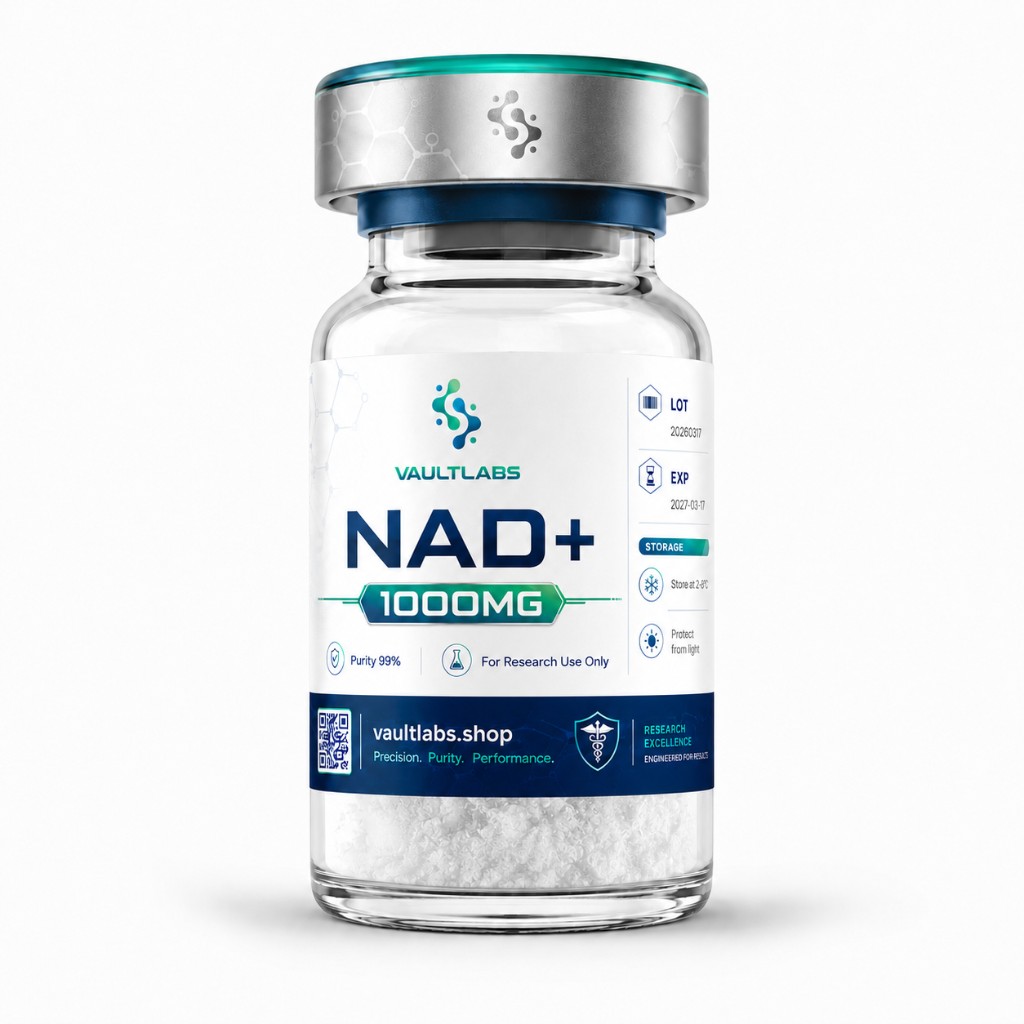
Searchers typing NAD+ research overview often want a wellness essay. VaultLabs will not write one. NAD+ on this site is a research reagent with a catalog name, a nominal mass, and a lot file. The page that owns UAE supply, dispatch, and commercial questions is NAD+ research UAE. This article is the identity map so that landing does not have to repeat reagent basics.
What you are receiving
VaultLabs lists NAD+ 1000mg as a lyophilized research presentation. The milligram figure is nominal catalog mass for inventory and stock-solution math. It is not a “dose” and it is not a wellness strength.
On receipt, match:
- Invoice SKU to vial print
- Vial lot to COA and batch verification
- Storage location to the label and the storage guide
If those strings disagree, quarantine.
Names that confuse purchase orders
NAD+, NAD plus, and nicotinamide adenine dinucleotide get used as if they were interchangeable SKUs. For receiving, the printed catalog string wins. Put literature synonyms in the ELN crosswalk, not on the fridge.
Do not inventory NAD+ on the same row as a peptide SKU “because both are lyophilized.” Different identities, different COAs.
Documentation
How to read a peptide COA still applies: methods, dates, and lot IDs matter more than a highlighted purity number. Interpreting assay results covers the numeric fields.
Cold-chain context for UAE summer receiving is cold-chain research supplies UAE. Get the parcel out of ambient heat before you open the paperwork.
Why NAD+ does not inventory like a peptide
Filing NAD+ on the same workflow as a peptide SKU is the mistake this page exists to prevent. It is a dinucleotide cofactor, not a synthesised peptide sequence, so several of the habits your team built around peptide receiving do not transfer.
Identity confirmation looks different. There is no sequence field to check, so a COA relies on other identity methods; a receiving officer trained to look for a sequence line will read the absence as a missing field rather than as the wrong expectation. Purity conventions differ too, and comparing an NAD+ purity figure against a peptide purity figure forces two different methods onto one scale.
Presentation differs as well. A 1000 mg format is an order of magnitude above the peptide vials on the same shelf, which means the stock-solution arithmetic your team does by habit will be wrong by an order of magnitude if the number is assumed rather than read.
The crosswalk worth writing once
Synonym confusion is the recurring cost here, and it is cheap to fix permanently. Write a single crosswalk row and keep it where purchasing can see it: literature name, catalog string as printed, SKU, and the inventory row it belongs to.
Do that once and the recurring questions stop being decisions. A requisition naming nicotinamide adenine dinucleotide resolves to the same row as one naming NAD+, without anyone improvising at the fridge. Related but distinct materials — precursors and reduced forms appear in the same literature — get their own rows rather than being absorbed into this one because the names look adjacent.
The crosswalk is a documentation artefact, not a scientific claim. It records what your institution has decided a name maps to, which is exactly what an auditor asks and exactly what memory supplies unreliably.
What this overview will not cover
Cellular “anti-aging” narratives, infusion culture, or human use. If a requester pasted a wellness blog into the PO justification, send them longevity research without health promises and ask for a reagent-level aim instead.
Vial-to-vial specification detail lives on NAD+ vial specifications. Buy/dispatch questions stay on NAD+ research UAE.
NAD+ from VaultLabs is for in vitro laboratory research only.
