
Documentation standard
Documented peptide supply vs undocumented listings
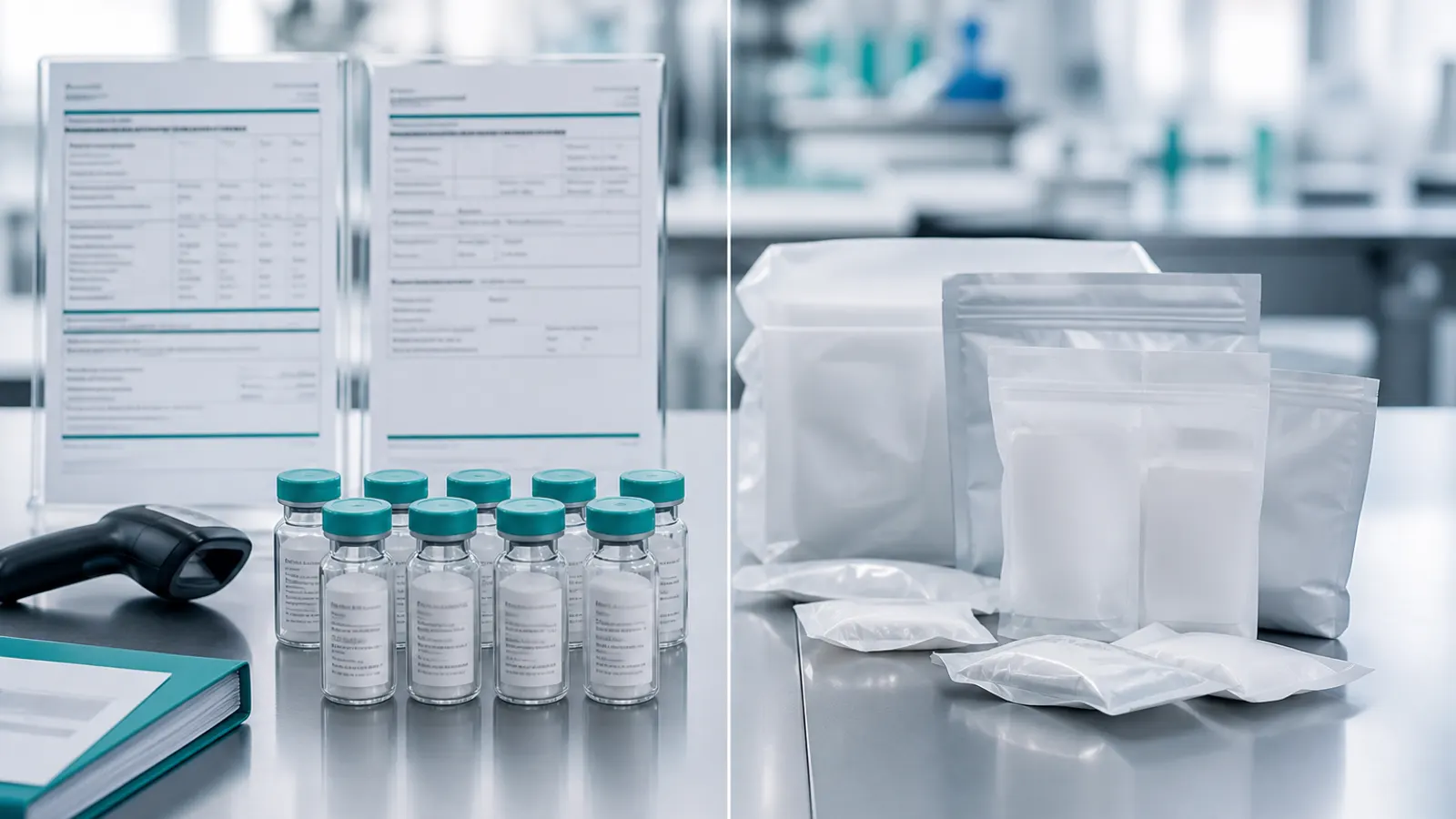
A Certificate of Analysis is only useful when it matches a physical lot. This comparison explains why documentation-first research peptide supply outperforms claim-only listings for UAE laboratories that need reproducibility and audit readiness.
All VaultLabs products are supplied strictly for laboratory and research use only. They are not intended for human consumption, medical use, personal use, or diagnostic use.
Category comparison only — VaultLabs does not name or disparage other companies on this page.
| Evaluation criterion | VaultLabs | Undocumented / claim-only supply |
|---|---|---|
| Batch-specific COA | Published when analytical release is complete | Generic purity claims without lot match |
| Online lot verification | Batch verify + COA search on vaultlabs.shop | Usually unavailable pre-purchase |
| Label ↔ record reconciliation | Designed for receiving QC workflows | Mismatched or missing identifiers |
| Documentation request path | Request documentation + support channel | Ad-hoc screenshots in chat |
| Institutional audit readiness | Order history + lot trail | Weak paper trail |
| Research-use positioning | Explicit RUO on every SKU | Often mixed with consumer language |
Why “99% purity” without a lot is not enough
Catalog purity statements without batch context cannot be reconciled at receiving. UAE institutional buyers increasingly expect lot numbers that match COA fields and vial labels.
VaultLabs treats COA publication as a controlled step: records appear online when uploaded for a qualified lot — not as evergreen marketing copy detached from inventory.
Your laboratory still defines acceptance criteria. Supplier documentation is a reference input, not an automatic pass for every assay.
A practical documentation checklist
Confirm lot identifiers on the vial, packing list, and published COA agree before releasing material into experimental use.
Photograph labels on receipt and store COA PDFs in your quality system alongside internal retest data where required.
If a lot has no online COA yet, use the documentation request workflow rather than proceeding on verbal assurances.
How undocumented supply creates hidden cost
Missing documentation delays vendor approval, blocks assay start dates, and complicates investigation when results drift between lots.
Informal sellers may appear cheaper until a single failed qualification cycle costs more than the material itself.
Documented supply is not about prestige — it is about continuity across experimental series.
What a lot number has to resolve to
A lot number is an identifier, not evidence. Take the string printed on the vial, look it up on the supplier's own domain, and check that the record which appears carries the same string in its own header. A number that resolves to nothing, or to a record naming a different lot, is decoration.
Three fields carry the weight at receiving: compound name, lot identifier and supplied form. Those must agree across the label, the packing list and the published record before any analytical value is worth reading. Document type — third-party or supplier — is labelled on each VaultLabs record, so the reader knows what they are holding. The guide to reading a certificate of analysis works through the fields in order.
Documentation earns its keep on the second order
A catalogue identifier records what you asked for; a lot number records what arrived. The difference surfaces when a result moves between two runs of the same procedure and someone has to establish whether the material changed — a question answerable only if both lots were written down at the time.
Undocumented supply removes the ability to ask. The material may well have been consistent; nothing was recorded either way, so the enquiry has no variable to rule out and the work gets repeated rather than explained. The batch verification guide covers logging a lot at receipt so the record still means something a year later.
Practical takeaway
For UAE laboratories that treat peptides as reference materials — not anonymous commodities — documented, lot-linked supply is the professional baseline. VaultLabs is built around that baseline.
For in vitro research use only. Not for human or animal consumption.